English
 Español
Content
- 1 What Versatility Means in a Pole Hedge Trimmer
- 2 Key Features That Define a Versatile Pole Hedge Trimmer
- 3 Corded, Cordless, and Petrol: Power Source Comparison
- 4 Reach, Weight, and Balance: The Ergonomic Triangle
- 5 Typical Applications and Cutting Scenarios
- 6 How to Choose the Right Model for Your Needs
What Versatility Means in a Pole Hedge Trimmer
A pole hedge trimmer earns the label "versatile" when it can handle a meaningful range of cutting tasks without requiring the operator to change tools, reposition ladders, or adapt technique around the equipment's limitations. In practical terms, this means a combination of reach adjustment, head articulation, power source flexibility, and compatibility with interchangeable attachments — features that collectively allow one tool to replace several.
The baseline expectation for any pole hedge trimmer is extended reach: the ability to cut the tops and upper sides of tall hedges from ground level, eliminating the need for ladders on most residential jobs. Versatility builds on that foundation by adding the ability to trim at multiple angles, work on both vertical hedge faces and horizontal tops without repositioning, and transition between hedge trimming and other garden tasks such as pruning or edging when the tool supports attachment swapping.
For homeowners with varied garden layouts — mixed hedge heights, angled topiaries, overhanging shrubs, and formal box hedging — a genuinely versatile pole hedge trimmer reduces job time substantially compared to a fixed-head model that requires constant repositioning or ladder setup.
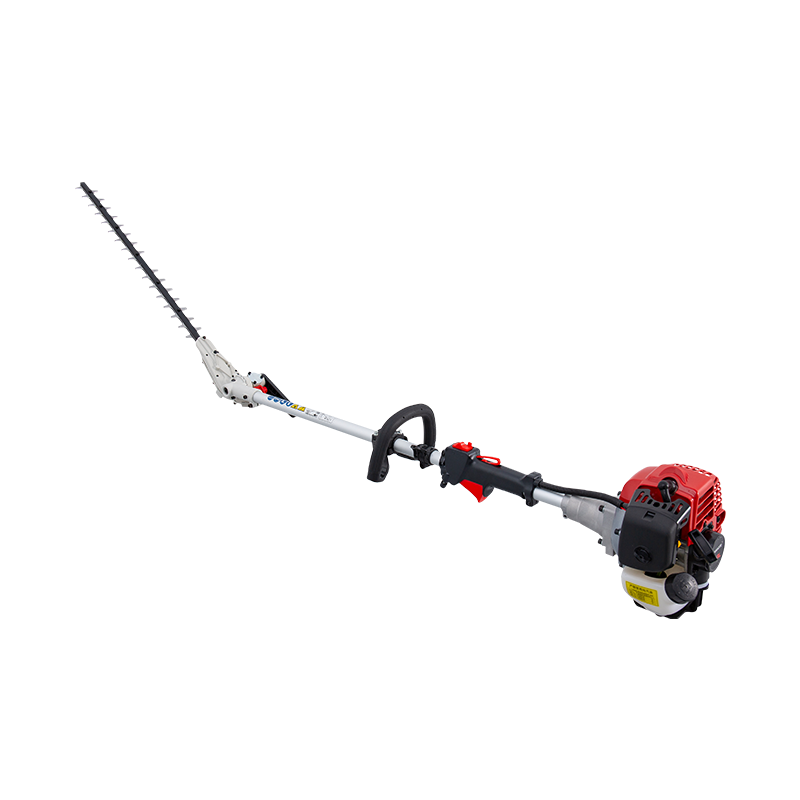
Key Features That Define a Versatile Pole Hedge Trimmer
Not all pole hedge trimmers marketed as versatile deliver equivalent functionality. The following features are the meaningful differentiators:
Articulating Head Angle
Head articulation is the single most impactful versatility feature. A trimmer head that pivots allows the operator to cut hedge tops horizontally while holding the pole at a comfortable angle, rather than forcing the pole directly overhead. Most quality pole hedge trimmers offer 5 to 7 locking positions spanning 0° to 135° or more. Models with tool-free, single-handed angle adjustment are significantly more practical in use than those requiring a lever or screwdriver to reposition.
Adjustable or Telescoping Pole Length
A fixed-length pole limits the tool to a specific reach envelope. Telescoping poles — typically adjusting from around 1.5 m to 2.6 m or more — allow the same tool to work on knee-height hedges and 3-metre-tall boundary screens without changing grip position or sacrificing control. Some multi-tool systems use modular pole sections that can be added or removed, offering even finer length customization.
Rotating Rear Handle
A rear handle that rotates independently of the pole allows the operator to maintain a natural wrist position when cutting at different angles. Without this feature, switching from vertical hedge face trimming to horizontal top cutting requires an awkward wrist rotation that fatigues the hand quickly. This feature is standard on premium models but often absent on entry-level pole trimmers.
Blade Length and Tooth Spacing
Blade length on pole hedge trimmers typically ranges from 40 cm to 60 cm. Longer blades improve cutting speed on large, flat hedge faces but are heavier and harder to maneuver in tight spaces. Tooth spacing — the gap between blade teeth — determines what stem thickness the trimmer can cut cleanly. Gaps of 16–22 mm suit the majority of ornamental hedging; wider gaps of 25–30 mm handle woodier growth found on mature privet, laurel, or hawthorn hedges.
Multi-Tool System Compatibility
Several major brands — including STIHL (KombiSystem), Husqvarna (Combi), Makita (Multi-Tool), EGO (Multi-Head), and Ryobi (Expand-It) — offer multi-tool platforms where the pole and power unit are shared across hedge trimmer, chainsaw, brush cutter, cultivator, and edger heads. For users who already own a compatible power unit, adding a hedge trimmer head at incremental cost delivers the highest total versatility per dollar spent.
Corded, Cordless, and Petrol: Power Source Comparison
Power source choice affects where and how long the trimmer can operate — a direct constraint on practical versatility:
| Power Source | Reach | Runtime | Weight | Best For |
|---|---|---|---|---|
| Corded electric | Limited by cable | Unlimited | Lightest | Small gardens near power outlet |
| Cordless (battery) | Unlimited | 30–90 min per charge | Medium | Most residential users |
| Petrol | Unlimited | Several hours (refuelable) | Heaviest | Professional / large estates |
Cordless battery-powered models have become the dominant choice for versatility-focused buyers. Advances in lithium-ion cell density mean that a 56V or 60V battery on a modern platform (EGO, Greenworks, Ryobi 40V+) delivers cutting performance that was exclusive to petrol tools five years ago, at significantly lower weight and noise output. For gardens up to roughly half a hectare, a spare battery eliminates runtime as a practical constraint.
Petrol pole hedge trimmers retain a meaningful advantage in professional landscaping contexts — particularly where all-day operation, full power in cold weather, and immediate refueling are priorities. The weight penalty of petrol units (typically 6–9 kg versus 3.5–5.5 kg for battery equivalents) is significant when the tool is held extended overhead for extended periods.
Reach, Weight, and Balance: The Ergonomic Triangle
Versatility on paper means little if the tool is uncomfortable or fatiguing to operate. Pole hedge trimmers introduce ergonomic challenges that short-reach hedge trimmers do not: the moment arm created by an extended pole amplifies the effective weight felt at the handle, and sustained overhead work taxes shoulder and forearm muscles rapidly.
Three factors determine how manageable a pole trimmer is in extended use:
- Balance point location: A well-balanced pole trimmer has its center of gravity close to the rear grip position, minimizing the effort required to hold the head aloft. Tools with heavy motors at the rear and lightweight blades at the front achieve this naturally; those with the motor at the blade end (common on direct-drive designs) are front-heavy and tire the operator faster.
- Shoulder strap compatibility: A harness or shoulder strap attachment point transfers the tool's weight from the arms to the torso, dramatically reducing fatigue during sustained operation. This feature is standard on petrol multi-tool systems and increasingly available on battery platforms. For jobs exceeding 30 minutes of continuous trimming, it is effectively mandatory for comfortable use.
- Anti-vibration damping: Vibration transmitted through the pole and handles contributes to hand-arm vibration syndrome (HAVS) with prolonged professional use. Quality pole trimmers incorporate rubber-isolated handle mounts that attenuate vibration at the grip without introducing flex that impairs cutting control.
Typical Applications and Cutting Scenarios
Understanding the scenarios a versatile pole hedge trimmer handles well — and where its limits lie — helps set realistic expectations before purchase:
- Tall formal hedges (1.8–3 m): The primary use case. Ground-level top trimming with the head angled horizontally, combined with vertical face trimming at mid-height, is where pole trimmers most directly replace ladders and offer clear productivity gains.
- Sloped or banked hedges: Hedges on embankments that are difficult to access from the high side are well-suited to pole trimmer reach from the low side. The articulating head compensates for the approach angle.
- Overhanging branches and shrub tops: Light pruning of overhanging growth along fences or pathways is achievable with a pole trimmer, though woody stems above the blade's tooth spacing rating will jam or stall the blade.
- Low-growing hedges and ground cover: With the pole shortened and the head angled downward, some pole trimmers can address low hedging or shaped topiaries. However, precision detail work on low-growing specimens is generally better handled with a short hedge trimmer or hand shears — the pole's length works against fine control at close range.
- Multi-attachment platform tasks: Users on a compatible multi-tool system can switch to a brushcutter, pruning saw, or edger head for tasks outside hedge trimming, completing diverse garden maintenance with a single power unit.
How to Choose the Right Model for Your Needs
Narrowing down a pole hedge trimmer purchase comes down to matching the tool's feature set to the specific demands of the garden and the user's physical capabilities:
Assess Your Hedge Height and Volume
For hedges under 2.5 m, most mid-range cordless pole trimmers with 2–2.5 m reach are adequate. For hedges consistently approaching or exceeding 3 m, prioritize models with the longest telescoping range and check the total reach including arm extension — manufacturers quote pole length, not total working reach, which adds roughly 0.6–0.8 m for the average adult.
Evaluate Battery Platform Synergy
If you already own cordless garden tools from a specific brand, purchasing a pole trimmer on the same battery platform eliminates the need for additional chargers and allows battery sharing. This is a significant practical and cost benefit — the battery often represents 30–50% of a cordless tool's retail price.
Prioritize Head Articulation for Mixed Cutting Tasks
If the primary goal is genuine versatility across multiple cutting angles and hedge profiles, head articulation with at least 5 locking positions is non-negotiable. A fixed-head pole trimmer is cheaper but provides reach extension only — not true versatility in trimming angle.
Consider Physical Capability Honestly
For users with limited upper body strength or shoulder issues, a lighter cordless model in the 3.5–4.5 kg range with a shoulder strap attachment will be used more frequently and more safely than a more powerful but heavier petrol unit. A tool that fatigues the operator after 15 minutes is not versatile in practice, regardless of its specification sheet.